Fast, honest roof repairs across Stratford-upon-Avon and Warwickshire. Clay tile matching for conservation properties, nail sickness assessments on estate housing, and all standard repairs with free quotes and no call-out fees.
Tell us the job in 30 seconds. No pushy sales, no call-out fee.
Roof repairs in Stratford-upon-Avon cost £150–£900 depending on scope — tile replacement, ridge re-bedding, lead flashing and valley repairs. We are NFRC registered, fully insured, and offer free quotes with no call-out fee. Call 01789 509542 for same-day emergency repairs across Warwickshire.
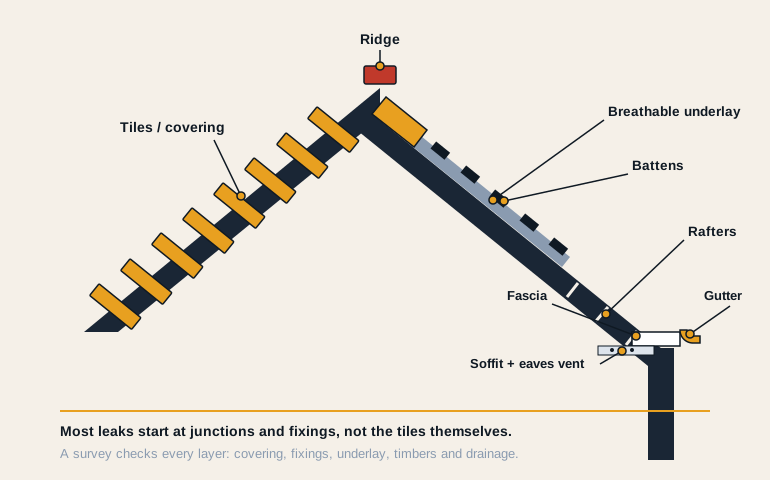
Most Stratford roof leaks trace to a handful of failures you can often spot from the ground with binoculars before any water shows inside.
When it is not the answer: If more than about a third of the covering has failed or the roof is riddled with nail sickness, repairing tile-by-tile is money wasted — a re-roof costs less over its remaining life. Read the full guide.
Stratford-upon-Avon’s housing stock spans roughly five centuries, which means roof repair work here covers more ground than in most Warwickshire towns. A morning job might be sourcing matched plain clay tiles for a Church Street conservation property; an afternoon job might be treating nail sickness on a 1970s concrete interlocking tile roof in Bridgetown. We have the skills and the contacts to handle both well.
The most common repair calls we receive from the Stratford CV37 area fall into four types: lead flashing failure around chimney stacks (most frequent on north-facing Victorian roofs on Evesham Road and Shipston Road); tile slippage due to nail sickness on post-war estates; valley gutter blockages causing water ingress after autumn leaf fall from riverside trees along the Avon; and cracked or slipped ridge tiles after winter freeze-thaw cycles.
| Job | Typical range | Notes |
|---|---|---|
| Slipped or cracked tile refix | £150–£250 | Per visit including access |
| Ridge re-bedding | £200–£500 | Per section, mortar or dry-fix |
| Lead flashing renewal | £300–£750 | Per chimney or abutment |
| Valley repair or rebuild | £350–£900 | Depending on length and access |
| Emergency make-safe | No call-out fee | Then repair quoted separately |
Worked example: A rear valley rebuild on a 1930s semi on the Bishopton estate, including tower access and waste, came in around £680.
No deposit on repairs under £500. Nothing is due before materials are on site, and we invoice with VAT shown separately.
For properties within Stratford’s Old Town conservation zone and other protected streets, Stratford-on-Avon District Council requires like-for-like material replacement. This most commonly means sourcing original-profile clay plain tiles rather than substituting concrete alternatives. We have established supplier relationships for salvaged and new conservation-grade clay tile stock, and we photograph and document all matched repairs for planning record purposes.
Free quotes, no call-out fees, honest advice.
We inspect the roof and the loft space, find the actual source of the leak (often not where the stain is) and photograph it.
You get a fixed price naming the exact repair, materials and access within 24 hours — no verbal guesses.
We book a slot that suits you and confirm whether a tower, ladder or scaffold is needed.
We carry out the repair, re-bed or mechanically fix tiles as needed, and re-dress any lead.
We clear all debris, leave the site tidy, and hand over a written guarantee on the repaired section.
| Job | Typical duration |
|---|---|
| Slipped or cracked tile refix | 1–2 hours |
| Ridge re-bedding (per section) | Half a day |
| Lead flashing renewal to a chimney | 1 day |
| Rear valley rebuild | 2–3 days |
Wet or high-wind days pause tiling and lead work — we build weather margin into every booking and never leave a roof open overnight.
Most Stratford repairs run from a tower or roof ladder; scaffold is quoted only where the job needs safe standing time at height. Scaffold is specified for: chimney-side repairs, full valley rebuilds, and anything beyond a day working at height - always itemised in your written quote, never a hidden extra, and we arrange it.
Victorian terraces off the Alcester Road and the Old Town lanes usually mean rear-access scaffold and permit-controlled pavement space, while the post-war Bishopton and Clopton estates give straightforward front access with room for a skip on the drive. Pavement scaffold and skip permits go through Stratford-on-Avon District Council; allow a few working days on streets like Sheep Street, Chapel Street, Church Street where space is tight.
Workmanship on the repaired section is covered for 10 years in writing; any replacement tiles or lead carry their manufacturer warranties on top.
If a fault appears in covered work, we come back and put it right. No quibbling, no re-charge.
BS 5534, the British Standard for slating and tiling, sets how tiles must be fixed and lapped so a repair matches the original roof's wind resistance. — to the NFRC and BS 5534
A repair done to standard means the new tiles are mechanically fixed where BS 5534 requires it — not simply hooked back into place — and any lead is dressed to the correct code. On Stratford's exposed north-facing and gable-end roofs, wind uplift is the real test of a repair, which is why we fix to specification rather than to whatever the original builder did decades ago.
A repair is usually a day of quiet ladder work with a small amount of tile debris — we sheet the area below and clear up before we leave. You do not need to stay home for external work - we just need power and access agreed in advance.
Repairs run year-round; if rain stops work mid-job we fit temporary weatherproofing the same day so nothing gets worse. The Avon Valley's humidity slows drying times through autumn and speeds moss growth on shaded, north-facing slopes near the watermeadows.
Covering CV37, CV35, CV36, B49, B50 and surrounding postcodes.
“Three tiles off the back slope after a stormy week. They came out within 24 hours, had matching clay tiles in the van and fixed it properly — no temporary patch. Really appreciated the speed.”
“Our Victorian semi on Evesham Road had failing lead flashing on both chimney stacks. They stripped and replaced both in one visit, dressed the lead properly and the stacks have been bone dry through two wet winters since.”
“Had repeated tile slippage on the Bridgetown house over five years. They finally diagnosed nail sickness clearly, showed me what it was and gave honest advice on repair vs re-roof. No pressure, just good information.”
Minor repairs — replacing a few tiles, re-bedding a ridge, or re-sealing a flashing — typically cost £150 to £400 in the Stratford area. Larger jobs such as replacing a valley, repointing a chimney stack or matching conservation-area clay tiles can be £400 to £900 or more. We offer free no-obligation quotes so you know the full cost before we start.
Yes. Sourcing matched clay plain tiles for conservation area properties in Stratford’s Old Town is a regular part of our work. We hold contacts with specialist tile salvage yards and manufacturers who supply conservation-grade stock. We advise on this in every survey for period properties in CV37.
Nail sickness is the corrosion of the iron nails used to fix slates or tiles on roofs from the 1930s to 1980s. As the nails corrode they lose their grip and tiles begin to slip. It is common on the concrete interlocking tile roofs of the Bridgetown and Clopton estates in Stratford. Once nail sickness is widespread, a full re-roof is usually more cost-effective than ongoing repairs.
If fewer than 20% of tiles are damaged and the roof structure is sound, repair is usually the right call. If tiles are slipping repeatedly due to nail sickness, the battens are rotted, or the felt has failed across large areas, a full replacement is more economical long-term. We will always give you an honest recommendation after a free survey.
No call-out fees. No obligation. Just an honest quote from a local Stratford roofer who turns up when they say they will.
01789 509542Conservative tile matching and Victorian lead flashing.
Regency parapet and Victorian estate repairs.
Conservation clay tile matching and rural farmhouse repairs.
Cotswold stone slate and exposed escarpment properties.
High Street conservation and Forest of Arden properties.
Village conservation area and post-war estate stock.
Nail sickness on 1960s–80s CV35 estate housing.
Riverside moisture conditions and Victorian High Street stock.
1930s–60s stock on Stratford eastern approach.
Elevated Arden village and period sandstone properties.
Edgehill wind exposure and period village properties.