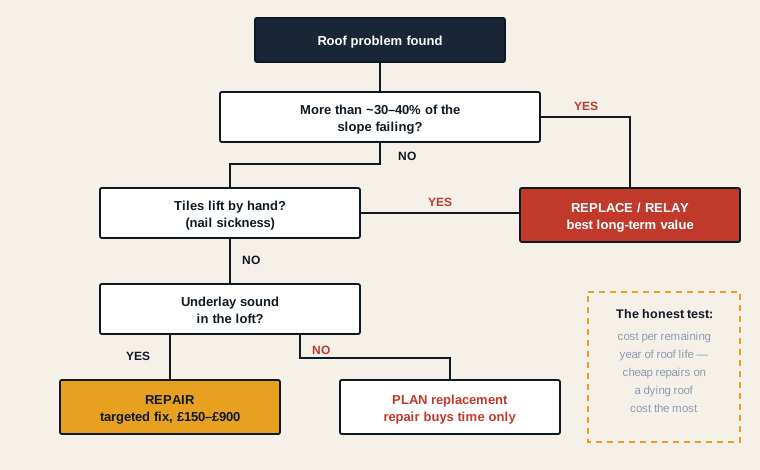
The most common question we are asked in Stratford-upon-Avon — and the one where a dishonest roofer can cost you thousands. Here is the framework we use, laid out plainly, so you can weigh it up before anyone quotes you.
Tell us the job in 30 seconds. No pushy sales, no call-out fee.
20+
Years Local
127
5★ Reviews
Free
Roof Survey
10yr
Guarantee
As a rule of thumb, repair when under a third of the roof has failed and the structure is sound; replace when fixings, underlay or a large share of the covering have reached end of life together. Compare options on cost-per-remaining-year, not headline price.
The framework
How to Decide, Step by Step
Three things settle almost every repair-or-replace decision: how much of the roof has actually failed, how old the covering is against its expected life, and what each option costs per year of life it buys. Work through them in that order and the answer is usually obvious.
Repair or replace: the honest decision framework
RICS and BRE stock-condition guidance both frame roof decisions around remaining service life and the proportion of elements failed — not age alone. A well-maintained roof can outlast its nominal lifespan by years. — per RICS / BRE stock-condition guidance
On-site checklist
The Five Questions We Ask on the Roof
When we survey a roof in Stratford, five questions settle the recommendation. You can ask them yourself before any roofer quotes you:
How much has actually failed? One area, or the whole roof at once? Widespread failure at a similar age points to replacement.
Is it the covering or the fixings? Sound tiles slipping because the nails have rusted is nail sickness — the tiles are fine but the roof needs re-fixing wholesale.
What condition is the underlay in? A perished or absent felt under the tiles is a re-roof signal even when the tiles look acceptable from the ground.
How long do you plan to stay? If you are moving in two years, a sound repair may be all you need; if this is your forever home, the cost-per-year maths favours replacement sooner.
What does the roof structure look like? Sagging or spreading rafters change the picture — sometimes the timbers, not the tiles, are the real job.
A roofer who answers all five in front of you, with photographs, is giving you an honest assessment. One who quotes a full re-roof without looking in the loft is not.
Extent of failure
How Much Has Actually Failed?
One slipped tile is a repair. A handful of slipped tiles across every slope, on the other hand, is usually nail sickness — the fixings rusting through at the same age all across the roof — and patching them one at a time just moves the problem along. As a guide: under about a third failed and the rest sound means repair; more than a third, or a perished underlay, tips the balance to replacement.
Isolated slipped or cracked tiles, sound elsewhere → repair
Slipped tiles across every slope at similar age → likely nail sickness, plan a re-roof
Torn, brittle or absent underlay in the loft → replacement territory
A single failed valley or flashing, covering sound → targeted repair
Age vs condition
Roof Life by Stratford Stock Era
Age is a guide, not a verdict — a sheltered, well-ventilated roof outlives an exposed, damp one of the same age. But it frames the decision. Here is how the common Stratford coverings tend to last:
Covering
Typical life
Common on
Concrete interlocking tile
40–60 years
Post-war Bishopton & Clopton estates
Clay plain / peg tile
60–100 years
Victorian & older Old Town stock
Natural slate
80–100+ years
Victorian terraces
Cotswold stone slate
100+ years
Rural CV35 / CV36 properties
Bitumen felt (flat)
10–20 years
Extensions, garages, dormers
If your roof is comfortably within these ranges and only a section has failed, repair. If it is at or beyond the range and failing in more than one place, get a survey before you spend money on patches.
The maths
Cost Per Remaining Year — the Honest Test
This is the calculation that cuts through it. Divide what the work costs by the years of life it realistically buys:
£900 of repairs that buy three more years = £300 a year
£7,000 re-roof that lasts 50 years = £140 a year
Seen that way, repeated cheap repairs on a roof near the end of its life are often the most expensive path of all — you pay again and again for time you were always going to lose. Equally, a £7,000 re-roof on a roof with fifteen good years left is money you did not need to spend yet. The honest answer is whichever option costs least per year of life, adjusted for how long you plan to stay.
What’s involved
Repair vs Re-Roof: What Each One Actually Means
The two options are not just different prices — they are different jobs, and knowing what each involves helps you judge a quote.
A repair is targeted: a day or less of ladder or tower work, replacing the failed tiles, re-bedding a ridge or re-dressing a lead flashing, with a small amount of debris and no scaffold on a straightforward job. It buys years, not decades, and it makes sense when the rest of the roof is sound.
A re-roof is a rebuild of the whole covering: scaffold up, old tiles and battens stripped, a new breathable underlay and treated battens laid, then re-tiled and the lead re-dressed, over several days. It costs more up front but resets the clock for 40 to 100 years depending on the material. On a Stratford roof with nail sickness across every slope, it is almost always the cheaper choice measured per year of life.
As a local worked example: a 1960s Bishopton semi came to us after four separate patch repairs in three years, each around £250. That £1,000 had bought barely any lasting improvement because the whole roof was nail-sick. A £6,800 re-roof ended the cycle and, spread over its 50-year life, costs about £136 a year — less than a single patch visit.
When replacement is oversell
When We Will Tell You Not to Replace
Plenty of Stratford roofs are quoted for full replacement when they do not need it. If your covering has decades of life left and the problem is one valley, one flashing or a slipped ridge, a repair is the right call and we will say so — even though the re-roof would earn us far more. A survey that ends in “yours is fine, here is the small repair it needs” is a good outcome, not a wasted trip. If you want that assessment in writing, a roof inspection gives you a photographed report and the fee comes off any work you book.
FAQs
Repair or Replace: Common Questions
If more than about a third of the covering has failed, the fixings are corroding across the whole roof (nail sickness), or the underlay is perished, repairs stop being economic and a re-roof costs less over its remaining life. A one-off slipped tile or a single failed flashing is a repair, not a re-roof.
A widely used rule of thumb: once repairs in any single year approach 30% of the cost of a full replacement, or once around 30% of the roof has failed, replacement usually becomes the better-value option. It is a guide, not a law — a good roofer will show you the maths for your specific roof.
Concrete tiles typically last 40–60 years, clay 60–100, natural slate 80–100+, and bitumen felt flat roofs 10–20. The Avon Valley's damp shortens the life of poorly ventilated or north-facing roofs, so age alone is not the whole story — condition matters more.
Yes. Replacing a sound roof because one section has failed is oversell. If the covering has decades of life left and only a valley or flashing has gone, a targeted repair is the honest, cheaper answer. We will tell you when a re-roof would be wasting your money.
It is the fairest way to compare options: divide the cost of the work by the years of life it buys. £900 of repairs that buy three more years costs £300 a year; a £7,000 re-roof that lasts 50 years costs £140 a year. Cheap repairs on a dying roof are often the most expensive choice.
Yes — a condition survey gives you a photographed assessment and an honest repair-or-replace recommendation, and the fee is credited against any work you book. It is the sensible first step when a roof is ageing but not obviously failing.
A like-for-like re-roof usually falls under permitted development, but listed buildings and some conservation areas need consent, and a change of material can too. We check this for your property before quoting so there are no surprises.