Roof flashing is the waterproofing detail where a roof meets a vertical surface — chimneys, dormers, walls and valleys. Failure is the most common cause of leaks on Warwickshire period properties. Chimney step flashing replacement costs £300–£750 per stack; the lead itself rarely fails, but pointing does.
Roof flashing is the waterproofing detail at every junction where the roof meets a vertical surface — around chimney stacks, where a lean-to meets the main house, along the sides of dormers, at parapet walls. When it fails, water tracks inside the building at that specific junction. Flashing failure is the most common single cause of water ingress on Warwickshire period properties. This guide explains what each type of flashing is, how it fails, and what repair and replacement costs.
The Main Types of Roof Flashing
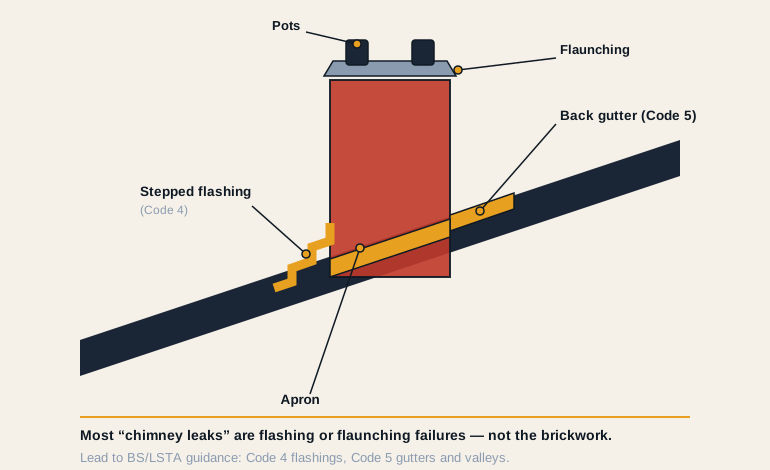
Step flashing — the most common type, used where a roof slope meets a vertical wall such as a chimney or a house wall. A series of individual lead soakers are woven between tile courses and folded up against the wall surface. On top of these sits the cover flashing, which is cut into a chase in the brickwork and pointed. When the pointing fails, the flashing drops away from the wall and water tracks behind it.
Apron flashing — a single piece of lead that covers the lower joint between a chimney and the roof slope, or the base of a dormer. Often the first point of failure on dormers added in the 1970s and 1980s.
Back gutter — the lead gutter that runs behind the chimney stack where it meets the main roof slope. Pond-formed lead that must have correct falls and a drip detail at each end. Failed back gutters are one of the most persistent sources of chimney-related damp in Victorian Warwickshire properties.
Valley flashing — the waterproofing at the junction of two roof slopes meeting in a valley. Can be lead or GRP depending on the property and specification. Lead valley liners on period properties last 60 to 100 years when correctly installed; later GRP valley liners typically last 25 to 30 years.
Verge flashing — on some roof types, a lead or mortar detail at the gable edge. Less common than the other types but present on some period Warwickshire properties with stone verges.
The Lead Sheet Training Academy specifies minimum lead codes and lap dimensions for each flashing application; chimney abutment flashings should be code 4 minimum, with code 5 for exposed and conservation work.
— Lead Sheet Training Academy — Rolled Lead Sheet guidance
How Lead Flashing Fails
The lead itself rarely fails through material degradation on period properties — code 4 or 5 lead correctly installed lasts 80 years or more. The failure points are almost always secondary:
- Pointing in the chase fails, the flashing drops away from the wall surface, and water tracks behind it rather than over it
- Thermal fatigue on large flat areas without adequate roll joints — the lead expands and contracts with temperature changes, fatiguing at fixed points over 20 to 30 years
- Inadequate original installation — surface-applied rather than wedged into a cut chase, code 3 used where code 4 or 5 is appropriate, incorrect lap dimensions
Surface-applied mastic, silicone or lead repair tape is not a permanent repair for any flashing failure. These materials mask the failure point rather than addressing it and typically last 18 to 36 months before the ingress resumes at the same location.
Flashing Repair and Replacement Costs in Warwickshire 2025
| Work Type | Cost Range | Notes |
|---|---|---|
| Chimney step flashing replacement | £300–£750 | Per stack. Code 4 standard, code 5 for conservation. |
| Apron flashing replacement | £150–£350 | Chimney base or dormer. Code 4 lead. |
| Back gutter re-dress | £250–£600 | Dependent on size and access. |
| Valley liner replacement (lead) | £80–£150/m | Minimum one-day job for access and re-tiling. |
| Valley liner replacement (GRP) | £50–£100/m | Faster installation, appropriate on non-conservation properties. |
| Re-pointing existing flashing | £80–£200 | Where the lead is sound but pointing has failed. |
Conservation Area Flashing Requirements
For properties in Stratford Old Town, Warwick castle conservation area, Leamington spa quarter and the designated conservation villages, lead is the required material for all visible flashings. Aluminium and modern composite products are not accepted on these properties. Code 5 is the standard specification for conservation and listed building work. All chase pointing must be in hydraulic lime — Portland cement pointing on a lead flashing causes chemical degradation of the lead over time.
Free Quotes Across Stratford & Warwickshire
NFRC registered. No call-out fees. Free written quotes within 24 hours.
📞 Call 01789 509542