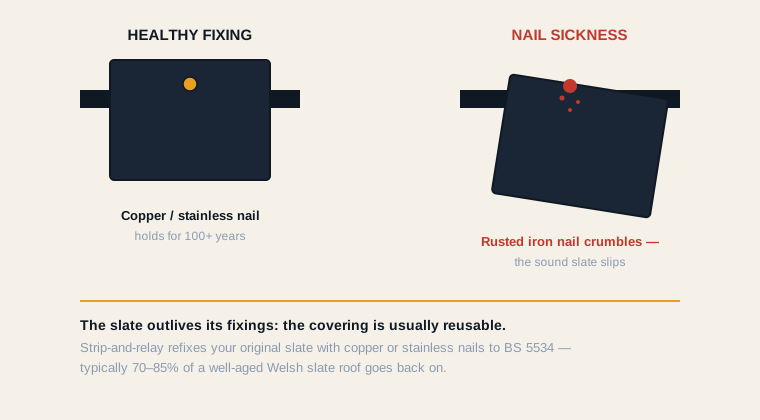
Nail sickness is when the nails holding roof tiles corrode and fail, causing tiles to slip. It is common on Stratford's post-war Bridgetown and Clopton estates, where 1960s–70s concrete tiles are now 40–50 years old. Once widespread, re-roofing is more economical than repeated repairs. A survey confirms which stage a roof has reached.
If you live on one of Stratford's post-war housing estates — Bridgetown, Clopton, parts of Shottery or Bishopton — and you have had tiles slip off your roof more than once in the last five years, the cause is almost certainly nail sickness. It is the single most common structural roofing problem we diagnose in Stratford, and it is predictable: a function of age, material and climate, not bad luck or poor original workmanship.
What Actually Happens
Concrete interlocking tiles were fixed to the tiling battens with iron or mild steel nails as standard practice from the 1950s through to the mid-1980s. Those nails are now between 40 and 70 years old and have spent every one of those years in the warm, moist, oxygen-rich environment of a roof void — ideal conditions for iron corrosion.
The corrosion process works from the inside of the nail outward, converting the iron into iron oxide (rust). As the nail corrodes, its cross-section reduces. A nail that was originally 3mm in diameter may have corroded to an effective 1mm — structurally still holding, but no longer holding well. The first indication is usually a tile on the south or south-west facing slope (the most thermally stressed elevation) slipping down by a centimetre or two without coming off entirely. Then another. Then one that falls.
Once the first tiles have moved, the problem accelerates. Adjacent tiles lose their lateral restraint and begin slipping under their own weight. What was one displaced tile becomes three. Three becomes eight. Each individual repair resets the timer on that specific tile but does nothing to the corroding nails holding the 200 others around it.
NFRC guidance identifies fixing-nail corrosion as a primary end-of-life failure for concrete-tiled roofs of the 1960s and 1970s — the exact stock that dominates Stratford's Bridgetown and Clopton estates.
— NFRC technical guidance
The Bridgetown and Clopton Situation
Stratford's Bridgetown and Clopton estates were developed predominantly between 1955 and 1978. Most properties have concrete interlocking tile roofs that have now been in place for between 45 and 70 years. In our assessment, a significant majority of these roofs are now in the mid-to-late stages of nail sickness, and a substantial proportion have already reached the point where the economics of continued repair no longer stack up against the cost of a full re-roof.
The complicating factor is that nail sickness develops unevenly. The south and south-west slopes — those receiving the most direct sunlight and therefore the most thermal cycling — typically fail first and fastest. The north-facing slopes on the same property may appear sound for another five to ten years. A homeowner who has had three south-slope repairs in four years sometimes assumes the north slope is fine. Our surveys often find that the north-slope nails are corroded to the same degree — the tiles simply haven't moved yet because north-facing slopes experience less thermal expansion and contraction.
📞 Free roof surveys available across all Stratford estates. Call ' + PHONE + ' for an honest assessment.
Repair vs Replacement: The Economic Calculation
The decision between continued repair and a full re-roof on a nail-sick Stratford estate property is ultimately a cost calculation, not a principle. We will never tell a homeowner they need a full re-roof if repairs are the genuinely better economic choice. But the maths is usually straightforward.
A typical emergency repair on a Bridgetown semi — attending, replacing two to five slipped tiles, re-nailing with stainless steel — costs £150 to £300. If that job recurs twice a year for five years, the total spend is £1,500 to £3,000. A full re-roof on the same property, including scaffold, strip, new breathable underlay, new treated battens, modern clay interlocking tiles and stainless fixings throughout, costs approximately £6,000 to £8,500. That re-roof then carries a 30-year design life and a 10-year workmanship guarantee.
The crossover point — where the cumulative repair cost exceeds the re-roof cost — depends on how aggressively the nail sickness is progressing. Our general guideline is that once tiles are slipping at a rate of more than three or four per year across the roof, and a full survey confirms widespread nail corrosion on all slopes, the re-roof is the more economical choice within a five-year window.
What a Re-Roof on a Stratford Estate Property Involves
A proper re-roof on a Bridgetown or Clopton semi involves more than stripping the old tiles and nailing on new ones. The tiling battens, which carry the tiles directly, are almost always replaced at the same time — they are typically original timber that has spent 50 years in a moist roof void and are no longer fit for purpose. The roofing felt underlay is replaced with a modern breathable membrane that manages moisture vapour from the living space below while remaining impermeable to water from above.
All new fixings are stainless steel. Every ridge tile is mechanically fixed as well as bedded. Every hip and valley is checked and, where necessary, the flashings are replaced. The finished roof is photographed and documented, and a written 10-year workmanship guarantee is issued. The scaffold typically remains for five working days and the site is left clean and clear each evening.